Paul Tustain outlines the case for gold.
Welcome to 'The Case for Gold'. I'm Paul Tustain, BullionVault's Director.
Many of our visitors ask our opinion about gold. To answer that question more thoroughly we have produced this electronic book.
For those of you in a hurry the introduction gives a quick version of the answer. For a more leisurely read it continues with several chapters within Parts 1, 2 and 3. You can read through the whole report with the links to left, or below.
Clearly it is not always right to be buying gold. Often - in fact, usually - it is better to go in search of business growth.
Right now we can look back over 25 years where the conditions have generally been very good for growing businesses. Unsurprisingly in those 25 years gold has underperformed business investments - by as much as 20 times.
But nobody makes money today from yesterday's price moves, and now there are many indicators which suggest things could soon turn very bad for investors seeking growth.
The list of dangers is getting longer. Here are a few:-
Budget deficits
Trade deficits
Asset bubbles
Financial systemics (open derivatives held on margin accounts etc)
The bond market overhang
Sovereign and corporate default risk
Accounting holes (e.g. corporate pension liabilities)
Foreign central bank currency mountains
Social program bankruptcies (medicare / medicaid / state pensions)
100% consumption, 0% saving
Demographics
Whether directly or indirectly most of these problems ultimately resolve to a single form. The savings of the developed world have been bound up in promises to repay, and it looks less and less likely that repayment is possible. The level of debt is the central problem threatening the wealth of today's investor, and keeping all that debt under control is becoming impossible.
The difficulty is that as economies move from a low debt to a high debt environment the self correcting nature of the economy changes. Overindebtedness seeks to correct itself either with rapid inflation which devalues savings indiscriminately, or with a deflationary squeeze, which kills specific businesses, and their creditors, through default. The current wild swings in interest rates demonstrate our monetary authorities trying with increasing desperation to prevent first one and then the other.
Economies rarely return to stability in an orderly way, and late moving investors usually get caught. Once even one or two percent of savers go in search of protection - to things like gold - prices change to the limit of what is acceptable to the rest, and they hold out stubbornly.
There is never enough room in the lifeboats of financial markets.
The world's oldest investors can just about remember the Great Depression. In America, from 1929's top to the bottom in 1932, the price of business assets fell by 90%. The purchasing power of gold, in terms of business assets, rose about seventeen-fold. The key during the deflation was to avoid default - i.e. your savings being lost to a failing financial institution unable to meet its obligations.
In the 1970s gold's price rose from $42 to $850. The price of business assets stayed approximately the same in money, with stock markets opening and closing the decade at broadly similar levels. Gold's business purchasing power rose about fifteen times. The 70s were a decade of worldwide inflation and stagflation, and this time the key was to avoid your money losing its purchasing power.
The following illustration shows just a sample of hyperinflations from the last hundred years.
In each case once the currency tipped over the edge the journey to worthlessness was rapid and painful. Gold stored offshore protected its owners from the consequences of these inflations. But in every case the local deposits and bond portfolios of the sensible saver were destroyed.
Underlying these hyperinflations there has been more than one root cause, and both lost wars and financial corruption have contributed. But the single most common factor was a failure to contain debt. When countries lose control of their public finances they can generally look forward to watching the value of their currency evaporate.
BullionVault's view is that the demands of modern democracy have caused the public finances of the USA to fall into the early stage of the same sort of death spiral while - tragically - its government and many of its people are distracted. At the same time in terms of fiscal irresponsibility Japan and the UK are not far behind, and Europe as a whole is far from healthy.
Our view is that the correction from this very high debt situation will directly cost a large percentage of savings. It will also deprive the world of the previously insatiable American consumer (we British are almost as bad, but there's not so many of us), and for a long time overcapacity in the world and a shortage of customers willing and able to pay will make productive business a painful and unrewarding pursuit.
Is this delusional? It is a bit embarrassing to be so publicly pessimistic, but we know for certain that we share these thoughts with more and more shrewd people, on whose behalf BullionVault now stores more than 1.8 tonnes of gold - mostly in Switzerland.
Argentina collapsed in 2001 when its sovereign debt hit $12,000 per family. The world's lenders had realised it would never be able to raise the taxes to pay back this debt, so they refused to fund it with ever more of their money.
This year the United States official public debt hit $83,000 per household. This public debt was only $20,000 in 1985, but even that was widely considered an irresponsible level and described mockingly as "Reaganomics". It has since then quietly quadrupled, which is the hidden cost of promising "no new taxes" while continuing to spend; both of which appear to be necessary to win modern elections in the USA. Currently each household's debt is growing by $5,000 a year.
The conventional view is to believe the US household capable of paying back this money through economic expansion, because apparently this will generate more tax. But this view makes little sense. Encouraging economic expansion is all very well when people are spending money they have previously saved, but in the USA saving has declined steadily from an already low figure in 2002, and turned negative in 2005. New spending will therefore need more credit, and if it is to be state sponsored the US Treasury will be adding to the $450 per month of increasing indebtedness every US family currently contributes to the US Government's public debt. Only bankrupts and gamblers think borrowing more is the solution to high indebtedness.
Since the options are so painful it is quite likely nothing significant will be done, and the public debt will continue growing in the meantime at about $5,000 per year per family. It will probably not be paid off until normal everyday banknotes have got one or two more zeros on them.
Would anyone in the US Federal Reserve sanction such inflationary money printing? It is unlikely, but it can be taken out of their hands. The market itself could take charge; it usually does.
One day we will hit the tipping point. Some small event will probably end up being identified as the direct cause and will knock the markets surprisingly hard. Whether it's a hedge fund implosion, a bank failure, a political crisis, or perhaps even a natural disaster, it will trigger the re-evaluation which will correct 20 years of overconfidence in the ability of borrowers to repay. It will be impossible to identify it as the beginning of the long slide back to reality until 10 years later, by which time it will be too late to be useful.
The bond glut
The US dollar has for a long time been the reserve currency of choice. The result is that for each US household there is now a total of about 440,000 in dollar denominated bonds spread out across the world (this includes commercial bonds denominated in US dollars). The size of this debt mountain has grown about 40 times in 25 years.
A big chunk of this debt falls due for re-financing every year, which places many billions of dollars in the hands of global investors, who are not especially loyal to the US dollar and must decide whether to re-invest in dollar bonds, or buy something else.
This $44trn aggregation is easily the largest stockpile of debt ever, and keeping it off the market requires near zero inflation. Once this frozen stockpile starts to melt it will be self-sustaining, and a trickle could turn quickly into a flood.
This is the conundrum at the heart of the world's monetary system. People will steadily realise that without inflation the US cannot pay its public debts and must default. Yet with inflation the overhang of bond money will flood the world with worthless dollars. Which is the way out? Default and deflation, or glut and inflation?
In a nutshell that is the case for gold, and the reason for BullionVault's existence. We don't pretend to know anything about timing. We just think this is one to be sensible and patient about.
The rest of these articles are here to fill in the gaps in this very simple viewpoint. We hope you get something from them.
The following articles are divided into three parts, each outlined below.
Part 1. History
"Those who cannot remember the past are condemned to repeat it" George Santayana
I chose these three episodes from the financial history books because I think each has something very important to say about our modern situation. Apart from that I enjoyed them too.
Chinese money management in the 13th century
British government debt in the 17th century
The depression of the 20th century
Part 2. Inflation
"We are about to enter an era of $400 billion to $500 billion annual deficits, and reach the point where it is almost impossible to borrow the money we need. The money we have worked so hard to save all our lives will be worthless." Warren B. Rudman (U.S. Senator)
We all have our favourite analogies...
Repulsive money : An electrostatic view of hyperinflation
Inflation without the spin : Debunking the CPI
Gold's upside : What price uselessness?
Part 3. Where to buy gold
"The complexity of this era of credit liquidation is far too great for the mob mind to grasp. It is hardly possible for them to see the picture wherein about 700 billion dollars of physical and intangible wealth is attempting to be turned into about 5 billion dollars of money" Robert Smitley [writing when 'money' meant gold.]
About buying gold safely, so you are properly set to profit. It's not as easy as you thought.
Why you should not buy gold from a bank
Where to buy your gold
A new and tax-efficient angle
And finally some unqualified observations on why so few people survive big financial crises.
"Those who cannot remember the past are condemned to repeat it."
George Santayana
Imperial collapse from monetary crisis.
From 1260, when Genghis Khan's grandson Kublai was Chinese emperor (and after a few earlier false starts) paper money finally took root.
To begin with there was an extensive system known as the First Mongol Issue which was over-issued as soon as it was successful and then depreciated rapidly. It was replaced on a 5:1 ratio by the much longer lasting Second Mongol Issue.
This ran from 1264 to 1290 and was famously described by the Italian adventurer Marco Polo - the first European to visit China and return to write about it :-
"The emperor's mint then is in this same city of Cambaluc, and the way it is wrought is such that you might say he has the secret of alchemy in perfection, and you would be right. For he makes his money after this fashion. He makes them take of the bark of a certain tree, in fact of the mulberry tree, the leaves of which are the food of the silkworms, these trees being so numerous that the whole districts are full of them. What they take is a certain fine white bast or skin which lies between the wood of the tree and the thick outer bark, and this they make into something resembling sheets of paper, but black. When these sheets have been prepared they are cut up into pieces of different sizes.
All these pieces of paper are issued with as much solemnity and authority as if they were of pure gold or silver; and on every piece a variety of officials, whose duty it is, have to write their names, and to put their seals. And when all is prepared duly, the chief officer deputed by the Khan smears the seal entrusted to him with vermilion, and impresses it on the paper, so that the form of the seal remains imprinted upon it in red; the money is then authentic. Anyone forging it would be punished with death. And the Khan causes every year to be made such a vast quantity of this money, which costs him nothing, that it must equal in amount all the treasure of the world.
Furthermore all merchants arriving from India or other countries, and bringing with them gold or silver or gems and pearls, are prohibited from selling to any one but the emperor. He has twelve experts chosen for this business, men of shrewdness and experience in such affairs; these appraise the articles, and the emperor then pays a liberal price for them in those pieces of paper. The merchants accept his price readily, for in the first place they would not get so good an one from anybody else, and secondly they are paid without any delay. And with this paper money they can buy what they like anywhere over the empire" The Travels
Inflation took hold in 1287. But even then life under this system remained extremely good. It was described by Alexander Del Mar, America's foremost monetary historian during the 19th century:-
"This was the most brilliant period in the history of China. Kublai Khan, after subduing and uniting the whole country and adding Burmah, Cochin-China, and Tonquin to the empire, entered upon a series of internal improvements and civil reforms, which raised the country he had conquered to the highest rank of civilization, power and progress. Tranquillity succeeded the commotions of the previous period; life and property were amply protected; justice was equally dispensed; and the effect of a gradual increase in the currency, which was jealously guarded from counterfeiting, was to stimulate industry and prevent the monopolization of capital. It was during this era that the Imperial canal, 1660 miles long, together with many other notable structures were built." History of Monetary Systems - 1886
The Second Mongol issue continued falling in value until in 1310 a third issue replaced the second, duplicating the 5 : 1 ratio with which the second had replaced the first. Then things changed markedly for the worse.
"Population and trade had greatly increased, but the emissions of paper notes were suffered to largely outrun both, and the inevitable consequence was depreciation. All the beneficial effects of a currency which is allowed to expand with a growth of population and trade were now turned into those evil effects that flow from a currency emitted in excess of such growth. These effects were not slow to develop themselves. Excessive and too rapid augmentation of the currency, resulted in the entire subversion of the old order of society. The best families in the empire were ruined, a new set of men came into the control of public affairs, and the country became the scene of internecine warfare and confusion." Del Mar
In the final phase of the Mongol dynasty in about 1350 huge efforts were made to correct the management of the currency but the situation was beyond repair, monetary paper having been issued in one form or another by all manner of private, provincial and government agencies in what amounted to an explosion of credit. The new Ming dynasty issued yet more paper currency with legislation stating "This paper money shall have currency, and be used in all respects as if it were copper money". There was no public confidence in this declaration and at the outset the paper traded at 17 : 13 against copper coinage. Before long the ratio fell to 300 : 1.
No historical episode is directly comparable with modern circumstances, but ancient China had some similarities. Its borders were secure, it was enormously confident in its institutions of state, it had enjoyed a prolonged period of economic success, and built its civic and commercial infrastructure on what amounted to capital issued for nothing. State and corporate paper had been injected in quantities which had never previously been imagined.
It left labour and enterprise happy and confident, which can correctly be looked on as the beneficial result of good money management. Indeed the economic policies of the period were at the time widely thought to be exceptionally enlightened and probably permanent - a view which persisted for several decades during a period of steady currency inflation.
Yet this prosperous and confident period preceded rapid financial and political decline. When the confidence in the currency gave way there was wholesale destruction of the value of savings in almost all forms at once, and the dynamism required to sustain empire rapidly disappeared. As its once respected institutions imploded the state itself was overthrown from the inside within a few years. That was the end of the Mongols.
Ancient China helps to illustrate one of the monetary roles of gold.
Well managed artificial money can support a good economy, but it will eventually collapse under the excesses of its period of greatest success. Eventually a few debtors fail. It takes very few failures before creditors start to see risk in every promise to repay. Their faith in their institutions evaporates, and they become acutely aware of the dangers of anything intangible or corruptible.
This is why gold re-materialises as a preferred store of value in times of severe economic distress. Artificially rare money is corrupted by over-issue, which is a powerful temptation when productive economic expansion has become difficult to achieve.
Gold drifts back into the background during times of sound economic management. A truth - unpalatable to the true gold bug - is that gold underperforms artificial money in an environment capable of supporting healthy business growth. Well managed artificial money allows the capital supply to expand and support the need for it by businesses which have the prospect of succeeding. Gold - on the other hand - rations capital. It cannot expand its supply to satisfy all the phantom business opportunities apparently offered by an advanced but creaking economy.
When economic environments are mature, and when profitable business opportunities are few, gold becomes a good way of storing value. It allows its owners to avoid being caught up in a currency whose supply is repeatedly expanded in search of business growth which is not going to happen.
A government defaults on its AAA rated stock
After England's brief flirtation with a republic Charles II was restored to the throne in 1660, but some of the royal powers his father had enjoyed were now shared with a representative parliament.
In particular the royal tax-raising privilege had been lost, leaving him forever begging taxes from his new governing partners. The process was slow because parliament met rarely and because the logistics of collection were complicated, so Charles was struggling to pay the bills.
At about this time the financial development of London was getting underway. The goldsmiths - whose traditional role was the fabrication of jewellery and plate - were emerging from a number of potential candidates as the trade group which would evolve into modern bankers. Their success grew from the safekeeping role of their vaults through the uncertain period of the English civil war, and also from the strength of London's position within growing European trade, with its frequent requirement to exchange foreign coin.
They soon found themselves able to lend as well, and from this they became the middlemen in a developing market in government debt.
It worked like this: armed with parliamentary permission to raise taxes Charles immediately cashed in by selling specific future tax receipts to the gold-rich goldsmiths, at a discount to the face value of the tax. To begin with the goldsmiths were unable to distribute the royal debt, and were soon incapable of lending the king more. So it was arranged that the debt redemption would in fact be paid not to the original goldsmith-lender, but to any bearer of the debt, thereby enabling the goldsmith to sell the debt on and replenish his cash, ready for the next royal loan.
The next problem was how to ensure the new bearer - not being the original lender - could reliably identify the authenticity of the debt. And here nature offered an ancient solution.
A piece of wood split down the middle will only match perfectly with its other half. So wooden sticks called tallies became a key component of English money supply. The government's debt office took a nice looking hazel stick and notched across it various symbols which denoted monetary amounts borrowed and lent. The stick was then split down the middle, with each side showing one end of the notches. One side - which had a wooden handle known as a 'stock' - was held by the king's treasury, while the other was given to the goldsmith.

The system was simple and effective and the the goldsmith-bankers proved trustworthy. They generated liquidity by trading what were by now being called 'stocks' between themselves, and they solemnly placed all the wooden sticks in their own vaults, next to their diminishing pile of gold and silver. They had good reason to remain honest as they were well placed in a profitable and rapidly growing market. For their part the wooden sticks thoroughly outwitted the forgers, and the king was the ultimate and trusted guarantor of all the debts.
Far from absurdity it was the perfection of the system which ultimately caused its downfall, because it led to a market far bigger than was ever healthy. To begin with the supply of cash came from the goldsmith bankers themselves. Then, with caution, they let out a little of the money they held on private current accounts, knowing that their own personal credit would get them sufficient cash if ever they needed it to repay their depositors in a hurry. Then they realised they could do better still by offering interest on private accounts held at notice, because the notice period would eliminate sudden cash calls. By paying interest they accumulated more public cash, and these funds were lent on to the king at an increasing rate.
Charles soon found he no longer needed to bother with parliamentary approval to raise taxes before issuing stock, because, like any modern day AAA issuer, he could sell it anyway, and from about 1668 it became generally accepted that the state's borrowings were secured by unspecified future taxes on the nation; an assumption which remains with us today.
The parliamentary brake on the speed of issue of this new monetary medium had now been sidestepped, and before long half of London was booming on credit evidenced by valuable broken wooden sticks. This was when things started to get harder.
As each tier of willing private depositors dried up it took another notch up the interest rate scale to squeeze out more of the public's cash. The goldsmiths could only offer to the king discounts which they could finance by attracting deposits, and by 1670 the king was having to accept as much as 10% per annum discount on the face of his 'stock' debts. Depositors were by now receiving 7% and the middlemen the rest.
By 1671 the system was hardly benefiting the king at all because redemptions were consuming all the cash subsequent issues could raise. He had sucked in all the private money he was going to get, so when at the year's end he demanded still more vital cash for his navy the bankers couldn't get it - at any price.
Annoyed, Charles conveniently remembered that the bulk of the loans which he had recently taken out had been at rates above the 6% limit permitted by his own usury laws. He declared the debts illegal and his own exchequer's payments stopped. This temporary action was enacted on 2nd January 1672, was extended after one year for another two, and after those two (subject to a few carefully chosen exceptions) it became indefinite.
The effect - often repeated since - was that those who lent to the state, and accepted a substitute deemed 'good as gold' in its place, turned out to have accidentally provided all their carefully accumulated personal wealth as voluntary taxes. The goldsmiths were blamed. They were caricatured as greedy opportunists and damned by their once enthusiastic depositors. Eleven of the biggest fourteen failed, leaving their chiefs variously (i) ruined, (ii) bankrupted (iii) on the run (iv) jailed or (v) dead.
The humble wooden stick never regained any serious credibility and lost out to a close cousin - paper.
You can visit the official government site of the USA's public debt (http://www.publicdebt.treas.gov/opd/opdpenny.htm).
A clear message from books written in another era.
It's hard to believe that the following passage was written in 1931:
"Prosperity was assisted, too, by ... stimulants to purchasing, each of which mortgaged the future but kept the factories roaring while it was being injected ... People were getting to consider it old-fashioned to limit their purchases to the amount of their cash balance; the thing to do was to 'exercise their credit' ... 15% of all retail sales were on an instalment basis ...It was fun while it lasted." - Only Yesterday, an informal history of the 1920's, F.L.Allen.
The 'stimulants to purchasing' of the 1920s were modest by comparison with our own times.
At the hint of a tailing off in economic activity governments are now certain to inject more demand, and the reliability of this intervention encourages business to use credit to the maximum of its ability. Companies adjust for safety-nets put there to protect them from economic downturns by taking bigger risks.
Few policymakers understand enough economics to realise that stimulating demand to protect jobs forces companies into taking more risks. In an environment skewed by government intervention, a cautiously managed firm quickly withers and falls victim to takeover by an aggressive one. The fittest business is the one which treads closest to the limit of safety without overstepping it; so move the limit and the fittest configuration for business must follow.
In our current environment most major successful businesses have extended themselves 'off balance-sheet', and into things like the derivatives markets. Here - under the disguise of clever financial management - they have underwritten financial contracts for fantastic amounts of money to generate small profits on large but improbable risks.
These derivatives are very like insurance, only the risk that is being insured is not a fire or a flood, but the equally low risk financial equivalent - something like "the yield on 10 year US Treasury bonds, less the yield on 5 year Japanese government bonds, divided by the yen/dollar exchange rate will not exceed x before the end of 2009". Modern derivatives are frequently very confusing, but in the end unlikely to go wrong.
But eventually they do. Procter and Gamble - a large cleaning products manufacturer - famously found out what can happen when their $200m borrowings were 'insured' by derivatives to save $7.5m over 5 years. When the impossible happened their small saving turned into a loss - effectively an insurance claim against them - of $157m.
Yet derivatives remain popular because for every Proctor and Gamble there are 50 smaller winners for whom the risk pays off, resulting in what amounts to financial insurance profits being generated apparently out of nowhere – from 'off' the balance sheet.
And in these lucky companies profits rise, their shares follow, and the brilliance of their financial management leads them to take over those companies more circumspect than themselves. So the derivative habit is perpetuated and companies start to rely for their profits on being lucky in financial insurance markets - rather than being good at doing something commercial.
You can see the evidence of this switching to financial activities in the leading companies in the stock-market, both in the growing dominance by totally financial businesses and in the increasing financial operations of manifestly industrial companies.
Banks - for example - have done particularly well. Government stimulation works by using the central bank to distribute large sums to a handful of giant financial organizations at a real interest rate of less than zero. This generous supply of cheap money is then disseminated through the network of financial products from complex derivatives to the humble mortgage, and as it trickles down it puts money in the hands of people to buy what they would otherwise have not bought. In its way it is a magnificent machine, but it isn't very safe in a crisis.
The problem is that it all rests on confidence in promises. Simple property can be owned only once. But once the habit grows of saying "you own a right", then soon everything is enmeshed in a web of undertakings, all defined in complex legal language which is dimly understood - even by the people who wrote it.
A typical London property is owned by the freeholder, who may lease it long term to a leaseholder. The leaseholder is mortgaged by a AA+ retail bank, which has packaged up 1000 similar loans into a mortgage backed security [MBS], which has been sold to raise funds to be recycled into the same profitable mortgage market. The MBS was channelled through an investment bank and had its currency switched on the foreign exchange derivatives markets to make it marketable abroad; the foreign exchange risk was merged into a default swap on an inferior rating at BB-. The rump was bought by a pension fund, but is so boring that it has been used to underwrite call options to squeeze an additional 5 basis points for what looks like a tiny risk.
The people who do these deals are clever, well paid, and work for big organisations of the type which can borrow money at exceptional terms from the waterfall of credit pouring from the modern central bank. You cannot help but admire their ingenuity and success.
But the structural weakness in their operation is that it relies on a belief rather than a property. Both sides depend on the confidence that it is more in the interest of the counterparty to behave honourably than to dispute a detailed clause in legal drafting which may have been written 7 or 8 years ago. It is when this confidence in each other breaks that the world witnesses a credit squeeze, and at that time a great many organisations dependent on credit are destroyed.
In 1954 J.K.Galbraith had this to say about the financial instruments of the time just before the Great Depression:-
"One of the paradoxes of speculation in securities is that the loans that underwrite it are among the safest of all investments. They are protected by stocks which under all ordinary circumstances are instantly saleable, and by a cash margin as well....A few firms made this decision: instead of trying to produce goods with its manifold headaches and inconveniences, they confined themselves to financing speculation...This was, possibly, the most profitable arbitrage operation of all time." The Great Crash
When that web of credit failed in 1930 Robert Smitley - writing in 1933 in the pit of the Great Depression - described the mad scramble to convert those promises back into property. He wrote this :-
"It is impossible for the mob mind to grasp the complexity of this credit liquidation. They cannot see the picture wherein about 700 billion dollars of credit is trying to be turned into about 5 billion dollars of money."
"We are about to enter an era of $400 billion to $500 billion annual deficits, and reach the point where it is almost impossible to borrow the money we need. The money we have worked so hard to save all our lives will be worthless."
Warren B. Rudman (U.S. Senator)
Hyperinflation is about unattractive money
Typically price rises in a hyperinflation massively outstrip the rate at which money has been recently issued, so it's not just about the rate of printing. There must be more to it.
The dollar became the world's reserve currency by having the longest reliable history of increasing purchasing power. That quality is intricately tied up with US economic expansion, because people who chose to save a dollar instead of spend it had a good chance of their money finding its way to a productive project, and later returning them more purchasing power than they originally saved.
But being a favoured international reserve currency is a double-edged sword. While the world chooses to accumulate your money everything is doubly easy. You put dollars into circulation and foreigners willingly accumulate them, allowing your citizens to enjoy the exports of the world at rock-bottom prices. What a life!
Unfortunately when you lose that special status everything changes. The flip side of being the world's reserve is that everyone is soon sitting on a great pile of your money, and you become exposed to the possibility that they dump it back into circulation.
High school science provides a useful analogy. A dollar is a bit like a positively charged atom existing in a world of negatively charged people. Like static electricity the dollars are attractive to the people.
At different times, depending upon the actions of central bankers, the attractiveness of dollars varies. If dollars store and gain monetary value over time, then like a strong positive charge they stick like glue in the pockets of their negatively charged owners.
This sticky money does not get spent as quickly as central bankers would like. Instead it is cautiously hoarded and economic activity stalls, eventually causing a cycle of falling prices - deflation - because it profits people to put off their spending. But money created by central banks can be injected into the economy to create a nervousness in savers; a hint that it should be spent or risk losing value. It makes the existing supply stick less in peoples’ pockets and keeps it circulating in economic activity.
Governments have discovered this economic trick. It is quite easy to do and appears to be so safe for such a long time that they have grown to rely on it as a trusted, indeed almost the only mechanism necessary for economic management. But it leads to aggressive inflation, and the reason for introducing the electric charge analogy is it can show us how.
As the tendency of money to increase in value diminishes towards zero its velocity around the economy increases because people and businesses become ambivalent about keeping it to store value. Like atoms with no charge these dollars are not attractive, so they don’t settle.
At this stage economic activity - which is measured by the rate at which these dollars are flying around - looks magnificent in all the statistics, but little of it is productive. What is actually happening is that people are ditching their dollars to find a better store of value, so what looks like 'growth' of the dollar economy is - more accurately - an exit.
You can see this happening wherever economic figures reporting in excess of your direct experience, and wherever alternative stores of value start to rise in price.
The expected central bank reaction to this kind of thing would be to raise interest rates, to bind the issued supply back into savers' pockets.
But this is where the catch is. The raising of rates can only be done when there is low risk of it causing debt servicing problems for large numbers of borrowers, because otherwise different risks arise. After a long borrowing binge consumer debt is high, corporate debt is high and public debt is high, and the increase of rates now risks causing previous borrowers to find their debt burdens unaffordable. This is a big problem, because it has been the demand of all these borrowing consumers which has been keeping the dollar saving habit profitable for decades.
So after polarization into savers and borrowers the monetary system is caught between two very unattractive options. The likely result is a runaway effect in which increasingly repulsive cash is dumped, while the central bank looks on, powerless to raise rates because it would induce previous borrowers to default.
It is made more severe when savers over the whole world have been stockpiling this currency as their reserve too. Hyperinflation needs no printing press if 35 years of surplus money supply has been frozen into savers' bond portfolios.
In such circumstances alternate assets - like the precious metals, cash commodities, well run foreign currencies, or the very few sound equities - rise in price to uncomfortable levels. These rises cause most savers to hold on to dollars in hope, fearful that having lost half their purchasing power already they'll lose another half by panicking out of weak currency into highly priced solid assets.
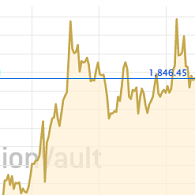
Towards the end of last year the US sovereign debt increased to $8 trillion - about $80,000 for every US family. The Iranians announced the termination of trading their oil for US Dollars. Russia decided to double its gold reserve. Gold coins minted in China disappeared off the shelves in hours. Gold's price continued to rise aggressively. In dollar terms gold has now much more than doubled from its 2000 lows of around $270. It is already an uncomfortable purchase - but that may be why it is such an important one.
A colourful look at boring numbers
One way to walk the tightrope between inflation and deflation is to pretend that everything is just as it should be.
An hour or so researching newspaper stories on "Google" should puzzle those who have read that inflation is - officially - running steadily on target at about 2.5%.
"Since 1996-07, the year before Labour came to power, the average council tax bill will have risen from £525 to £1,053." The Times - Feb 20 2006.
"The UK's biggest energy supplier will raise gas and electricity tariffs by 22% from 1 March 2006. " www.bbc.co.uk Feb 17 2006
"A single Tube journey in zone one will cost £3 instead of £2 while a single bus journey will rise from £1.20 to £1.50, said Mayor Ken Livingstone." www.bbc.co.uk Oct 2005
"Prices for houses in London were up by 7.2 percent in the three months between November and February" www.worleconomies.co.uk
"Tesco was the first to announce an increase in its retail milk price of 2.2 pence per litre, and now all of the major retailers have followed suit with increases of between 2 and 4 pence per litre." http://www.tumpline.com 26 January 2006
"Average [water] bills in England and Wales rose by 11.8% in 2005. This time around, the average increase is 5.5%, roughly double UK inflation." http://news.bbc.co.uk 30th March 2006
"The price of a standard UK passport is to rise by 21%" www.bbc.co.uk 17 November 2005
"Overall fuel costs for companies were 39 per cent higher last month than a year before, the sharpest rise since 1991, according to figures released yesterday." The Times - 13 Sep 2005
"Other official data paint a slightly different picture of recent earnings developments. Since June 2005, the ONS has published a new experimental series: the average weekly earnings (AWE) measure [+4.3%]... the factors behind that divergence are unclear at present." http://www.bankofengland.co.uk/ February 2006
"In 1985 the average annual cost of sending a child to private school was £1,806 compared to £8,388 in 2005, an increase of 364%" Independent Schools Council (ISC) - August 2005
"The latest data from the ONS says that income tax payments were 7.5 per cent higher in the year to the end of March 2006 than in the previous year. An equivalent measure of National Insurance showed a rise of 5.8 per cent over the same period." http://www.telegraph.co.uk/ May 2006
"Price of British beef 'to rise by 20%'. The price of British beef is set to rise after exports to Europe resume next week...Increased wholesale prices are likely to be passed on from supermarkets to shoppers, the National Beef Association (NBA) warned. Exports will resume from May 3, finally ending the ban brought in a decade ago to stem the spread of mad cow disease (BSE)." http://finance.pipex.com April 2006
"The average Old Trafford price rise will be 12.3 per cent" Manchester Evening News -10th April 2006
"the maximum you'll be asked to contribute towards your tuition fees is £1,175 in 2005/06 ..... If you are starting a full-time undergraduate course in 2006/07 you may have to pay a contribution up to a maximum of £3000 a year" www.aimhigher.co.uk 2006
"Premium increases very closely follow healthcare spending increases over time. Over the most recent ten-year period (1993-2003) for which data are available, premiums grew at an annual rate of 7.3 percent, while the cost of healthcare services grew at an annual rate of 7.2 percent." - PriceWaterhouseCoopers - The Factors Fuelling Rising Healthcare Costs 2006.
"Price inflation in the private sector for residential care and some other contracted services (such as repairs and maintenance of buildings) has also been much higher than the retail price index (RPI)." Hampshire County Council - February 2006
"The cost of a UK first-class stamp has risen by two pence to 32p [6.7%]" www.bbc.co.uk April 2006
"In the past three years, inflation has risen by 4.6 per cent while the cost of running a house increased by 14 per cent. Rises in mortgage interest payments most contributed to the cost of owning and running a house in 2004/05 – rising by 20 per cent to an average of £2,146, according to the research, which is based on data from the Office for National Statistics." www.aboutproperty.co.uk - March 2006
The Bank of England's Monetary Policy Committee has an inflation target of 2.0%. Previously inflation was measured using the 'Retail Prices Index', which was used consistently - so long as interest rates were falling. When rates rose again they quietly switched to focusing on RPIX, which excluded interest rates, and then reverted to RPI when rates turned down. This allowed the most widely reported inflation figure to enjoy - repeatedly - a one way ratchet of cyclically falling rates.
The RPI includes neither houses nor retirement income, two of the biggest expenditures which most people have, and the cost of both of them were rising sharply through the 80s and 90s.
Recently the Bank of England switched to the CPI, a European standard. It doesn't include houses or retirement income either. In fact it has an even more convenient mix of data, and consistently reports a lower inflation figure than RPI:
"...the RPI covers owner-occupied costs and council tax and the CPI doesn't although it does cover new cars, personal computers and air fares that the RPI doesn't" http://www.pcs.org.uk
There is a pattern. The owner-occupied costs of plumbers and electricians have been increasing because of many extra costs imposed on their employers, like National Insurance Contributions and increasing Health and Safety costs. Council tax has been rising fast too.
On the other hand because of increases in competition from no-frills airlines European air fares have plummeted.
Personal computers and cars are interesting too. The statisticians use 'hedonic' computation, which means that product improvement impacts the reported inflation figure. So a basic computer, which doubles in capability every 18 months, is computed as a halving of price even though the price of a basic family computer does not fall at all.
In the same way a modern day BMW 7 series (£38,000) on any car criteria greatly outperforms a 1970s Rolls Royce (£50,000 then). The result is that in a statistician's spreadsheet luxury car prices fall steadily over 30 years. In fact a new Rolls Royce has risen from about £50,000 in 1970 to about £200,000, and a top of the range BMW by a similar percentage factor.
It is getting increasingly silly. The new target is 'Core CPI', which excludes housing, its associated costs and taxes, (mortgages and council tax) the cost of retirement income, and now fuel and food too! It seems improbable that savers will be impressed by this sort of selectivity indefinitely, unless they believe it useful to measure the purchasing power of savings only by comparison with the tumbling prices of imported Chinese clothing and electronic gadgetry.
Understand your upside before buying gold
The number of zeros on formal statistics sometimes disguises their real meaning.
The US government currently borrows $5,000 a year on behalf of each US
family, which it dares not tax for electoral reasons. This is the
source of the budget deficit. That uncollected money remains in the
hands of the family, which currently prefers buying foreign goods and
spends $5,000 on them, producing the trade deficit. The foreign
supplier sends the $5,000 back to the US by buying government bonds and
American businesses. This money from abroad is the source of the
fine-sounding US capital inflow.
Give or take $1,000 this same $5,000 deficit triangle is completed for each of about 100 million US households every year, and that is why there is a $500 billion budget deficit, and similar trade deficit and US capital inflow. It is tempting to assume that this is the way it has always been and that somehow it must be stable, but that is wrong. This is a wholly new way of arranging things.
The last four-year administration ended having increased the average US family's gross future tax debt by about $19,000. The family's total accumulated uncollected tax - i.e. its share of the country's public debt - grew by that $19,000 to about $74,000, three quarters of which has been built up since 1985. The demand which has sustained growth for twenty years has arisen from this money being spent twice, once by the family, and once by the state, and this duplicated spending is the only explanation that is needed to understand the remarkable strength of the USA's economy. But the legacy of it was this $74,000 tax debt for each of just over 100 million families, which just 18 months later has grown to $83,000.
How serious is an $83,000 tax debt? We don't know because it has never happened before, but we do know that in Argentina in 2001 their sovereign public debt was about $12,000 per family, and at that level it triggered the capital flight which was the direct cause of their debt default and subsequent economic crunch. It is both extraordinary confidence in underlying USA economic robustness and an apparent lack of alternate options which appears to be preventing a similar US setback. But the confidence rests on the demand strength, which itself arises from the scale of the deficit triangle.
To resolve the US public debt problem safely is very difficult. Raising taxes to the required level is unthinkable - both electorally and because it would hurt domestic spending and feed back into a deflationary spiral of declining output and demand. Trade protectionism was tried before and it triggered tit-for-tat export restrictions and global depression. The only viable route out is devaluation of the debt, which is equivalent to inflation.
Assessing how severe the coming inflation might be is also difficult, but it is possible to get an idea by looking at the bond market. For twenty five years the bond market has been growing fast, to about 40 times what it was in the early eighties. Through most of that time interest rates and inflation were falling, so fixing a rate of return with a bond was an attractive option for a saver. As a result while borrowers were spending savers were diverting their cash out of the economy and freezing it in bond portfolios, until eventually US dollar bond markets have grown to contain 50 times all the dollars in current circulation.
This frozen money is up for redemption over the coming years so it will turn back into cash, and little of it can sensibly be re-invested in bonds with inflation threatening and rates turning up from long cycle lows. In any event much of it must be returned as consumable cash to the retiring boomer generation.
This suggests a possible cash glut in the medium term, and that indicates inflation too. Aggressive inflations do tend to follow an accumulation of official indebtedness. It would be unusual if the current US situation did not result in something similar.
Fear of this should have already caused a downwards dollar correction, but this has not happened because the alternate currencies have similar problems. The Yen is afflicted by an equally difficult sovereign debt problem, while the Euro looks politically unstable and can agree neither a constitution nor an ongoing budget. Commodities on the other hand have been rising in price - and gold particularly so.
Gold is famously useless in almost everything except that it cannot be made, and is reliably difficult to find. Even now if all the gold ever produced on Earth were formed into a single cube its edge would be less than 20 metres - 2 metres shorter than a tennis court. Annually mined production grows that cube by about 12 centimetres a year, and more than each year's production is used up by jewellers such that now 75% of that cube is fabricated in an art form worth several times its bullion value. Meanwhile after 15 years of consistent selling into private demand central bank ownership is now down to about 20% of the world's gold.
That 20 metre cube of gold would weigh about 140,000 tonnes and each tonne is worth about 20,000,000 dollars. So all the gold in the world is currently valued at $2.8 trillion, which compares to a US public debt of $8.3 trillion, and an unreserved US generational debt of $44 trillion. By contrast the US has the biggest gold reserve in the world which at 8,000 tonnes is worth only $0.16 trillion, enough, were it all sold, to stop the deficits growing for about 12 weeks.
Arising from this there are are powerful fundamental forces at work on the gold price which cautious savers understand intuitively - even if some cannot put their finger on what those forces are.
The value of anything reflects its utility at the margin, which means it only needs a slight shortage to create price surges and a slight surplus to create price slumps. The utility of gold is simply that it is rare, and for 5,000 years people have used reliably rare stuff to store value for the future. They call it money.
Almost all human societies have been able to arrange and enforce a respectable rarity of artificial forms of money, and so long as savers have been able to trust in this artificially created rarity the marginal utility of gold's natural rarity stays low. Paradoxically 'rarity' is in adequate supply wherever artificial money is being reasonably well managed, and this makes gold's natural rarity less valued in those times.
But what savers are now realising is that official money is not being well managed and cannot in future be relied upon for rarity, and they believe there will soon be great quantities of artificial money in circulation. Even if the underlying demand for rare stuff were to stay the same then the value of the few naturally scarce things would go up. Much more likely is that the underlying demand for natural rarity will increase, and it's utility at the margin, where a diminishing supply of rarity meets an increasing demand, will continue to force up the price.
This is what is happening to gold now. Arising from the scale of public debt and the enormous overhang of dollar bonds savers are valuing the unimpeachable rarity of gold higher. More and more people no longer believe that the artificial rarity of dollars are offering that same assurance of future scarcity, and until responsible fiscal and monetary management returns to government the outlook for gold is likely to remain resolutely positive.
"The complexity of this era of credit liquidation is far too great for the mob mind to grasp. It is hardly possible for them to see the picture wherein about 700 billion dollars of physical and intangible wealth is attempting to be turned into about 5 billion dollars of money."
Robert Smitley [writing when 'money' meant gold.]
Take care when buying from a bank
As you set out to buy gold the first thing you need to know is that 95% of the world's gold traders will automatically sell you the wrong type.
Unallocated gold is the most widely traded form of gold in the world. It hides a way of advantaging the provider - usually a bank - by subjecting buyers to a risk they will frequently remain unaware of until it is too late. The widely quoted 'spot price' refers to this unallocated gold, and this is how it works:-
When a
bank sells you unallocated gold on the spot market you become a
creditor - i.e. the bank owes you gold which you do not own. The
bank is taking advantage of the fact that you are not quite sure what
to do with any gold you buy, and it feels logical - to most gold buyers
- to put the gold safely in the bank. When you do this you
become, in law, a depositor of gold. Most people now relax in the
belief that they own gold completely securely, and they do not pay the
little extra - above the spot - to have their trade formally
'allocated'.
A bank is required by its regulator to hold a proportion of its
liabilities as certain types of assets capable of being turned into
cash quickly during times of crisis. It is a liquid reserve
and it's there to protect the bank from a common type of problem - a
liquidity crisis - which occurs when a bank has short term deposits,
long term loans, and insufficient cash to meet the immediate demand for
withdrawals. Physical gold bars are accepted as a very good form
of liquidity reserve because they can be turned quickly into cash.
If a bank has physical possession of some gold which it owes you as its
creditor the bank itself is the current owner of the gold. While
this gold remains unallocated to you the regulator considers it part of
a bank's liquid reserve. This makes unallocated gold an
attractive way for the bank to maintain its regulated liquidity,
because you have paid for your gold, and the bank is free to use your
money, while it is also able to add your unallocated gold holding to
its own reserve.
So your unallocated gold would be ditched if the bank were in need of
cash. It has no choice in the matter because liquid reserves are there
to be sold at short notice to protect the bank's general creditors -
all of whom, including you, must receive a proportionate share of
whatever is raised from the sale of assets should the crisis deepen and
the bank become insolvent.
If that did happen you would be in a bad position. The bank's
small gold reserve would be diluted by non-performing bond portfolios
and other assets which don't sell well in a crisis. The last line
of defence for bank depositors is deposit protection, which is a state
underwritten mainstay of banking confidence in the West. But it
does not apply on bullion debts like yours. Deposit protection is
there as a confidence-builder for the national currency only, which
means unallocated gold actually offers less protection from bank
failure than a cash deposit. So having been the provider of the
bank's liquidity reserve you will then be in the minority of those
offered no protection by the state's guarantee.
So it is important not to be impressed by unallocated gold, or by it being physically stored in a bank's vault, or by it being checked daily by bank regulators. Regulators are checking it to make sure the bank maintains a liquid reserve, and they are not interested in your entitlement as a bullion creditor.
Allocated gold is different because you become the outright owner of gold and you are no longer a creditor. Your allocated gold is your property and it cannot be used as the bank's reserve, so with allocated gold you get proper protection from systemic failure.
Unfortunately with allocated gold your money does the bank no good. And since modern banks reckon to earn 20% each year on capital employed, their loss of use of your allocated gold is disappointing for them. This is why banks usually charge nothing for unallocated storage and at least 1.5% per annum for allocated storage, with the result that professionals in the bullion market reckon that less than 1% of gold traded within financial markets is allocated.
This is how the huge majority of the world's owners of bank held gold are - probably unwittingly - storing their personal reserve in a way which fails to meet the most common objective of gold buyers.
Unlike banks some suppliers buy real physical bars. BullionVault is one, and it buys its gold from a major international bullion dealer, which also deals in volume with counterparties all over the world. BullionVault insists on physical delivery of bars into ViaMat vaults, which enables BullionVault users to become the outright owners of the gold they buy. It costs an extra dollar and a half an ounce.
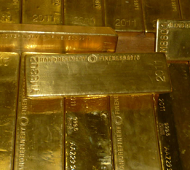
As its customers buy gold BullionVault re-loads its inventory with physical purchases. So its 'Bar List' gradually grows, with batches of bars delivered sometimes a few days apart, and sometimes a few weeks. The bars were originally manufactured by a refiner, and stamped there with their unique bar numbers. They are the normal 'Good Delivery' size of 400 oz, which is the standard specification used to settle physical bullion market deals.
You can check out the actual BullionVault ViaMat list if you want because it is published daily on the internet (at http://www.bullionvault.com/audit/london_gold.htm) but the table below shows the important data.
| Bar No | Location | Delivery |
| 5812 | Zurich | 18-Jan-06 |
| 5813 | Zurich | 18-Jan-06 |
| 5814 | Zurich | 18-Jan-06 |
| 5815 | Zurich | 18-Jan-06 |
| 5816 | Zurich | 09-Feb-06 |
| 5817 | Zurich | 09-Feb-06 |
| 5818 | Zurich | 09-Feb-06 |
| 5819 | Zurich | 09-Feb-06 |
| 5820 | Zurich | 14-Feb-06 |
| 5821 | Zurich | 14-Feb-06 |
| 5822 | Zurich | 14-Feb-06 |
| 5738 | Zurich | 09-Mar-06 |
| 5739 | Zurich | 09-Mar-06 |
| 5740 | Zurich | 09-Mar-06 |
| 5741 | Zurich | 10-Apr-06 |
| 5742 | Zurich | 10-Apr-06 |
| 5743 | Zurich | 10-Apr-06 |
| NS 1226 | London | 09-Jan-06 |
| NS 1227 | London | 09-Jan-06 |
| NS 1228 | London | 09-Jan-06 |
| NS 1229 | London | 03-Feb-06 |
| NS 1230 | London | 03-Feb-06 |
| NS 1231 | London | 03-Feb-06 |
| NS 1232 | London | 21-Feb-06 |
| NS 1233 | London | 21-Feb-06 |
| NS 1234 | London | 21-Feb-06 |
| NS 1235 | London | 14-Mar-06 |
| NS 1236 | London | 14-Mar-06 |
| NS 1237 | London | 14-Mar-06 |
| NS 1238 | London | 25-Apr-06 |
| NS 1239 | London | 25-Apr-06 |
| NS 1240 | London | 25-Apr-06 |
See how over the four weeks from 18-Jan 2006 to 14-Feb 2006, with the delivery of three separate purchases, the bar numbers delivered to BullionVault in Zurich are sequential. Then over the four and a half weeks from 19-Mar-06 to 10-Apr-06 they were sequential again, for 2 more deliveries. Then in London notice that all five physical deliveries between 09-Jan-06 and 25-Apr-06 are sequential too.
What seems like a logical conclusion (and BullionVault's main market dealers have confirmed it) is that BullionVault is the only customer of this major firm to trouble it with the hassle of delivering the actual physical bars.
Trading gold on the ledger is cheaper and faster for banks, and it is natural - if sometimes wrong - for banks to think themselves 100% credit-worthy. With so much gold out there being unallocated investors should be careful because a financial crisis might not be profitable for them, and it ought to be.
The thinking behind BullionVault
It used to be very difficult for private individuals to find a secure, accessible and cost effective way of buying, storing, and later selling gold.
The big problem was that the narrow trading spreads of the professional bullion markets required settlement in 'Good Delivery Bars', so if you couldn't make delivery in these bars you were excluded from enjoying professional market prices.
These bars are both very large (usually 400 troy ounces [12.4kg]) and must have been kept continuously in recognized bullion vaults from the date of their original manufacture. So just having enough money to buy a bar or two was only half the problem solved. You needed a relationship with a formally recognised bullion vault, and generally they are not accessible to retail customers. The entry level was typically 15 - 20 big bars.
So the only route for retail buyers used to be small bars without the good delivery status, and this meant high dealing costs. Retail trading spreads were typically 4-6%, which compared to about 0.4% for main market gold.
BullionVault resolves this problem. It lets you buy a small part of the high-quality big bars in a way which eliminates the loss of value associated with buying small bars. The saving is substantial. It also guarantees your gold has never been tampered with.
On BullionVault you buy whatever quantity of gold you like. Trading is in multiples of 1 gram, instead of the 12,500 grams of a normal good delivery bar. You choose your preferred ViaMat vault from London, New York or Zurich.
When you choose to sell you can find gold buyers at BullionVault, and whereas before they probably would have thought you an untrustworthy seller, now, with your gold having stayed in good delivery bar form within BullionVault, your gold's quality is guaranteed. So as a seller you'll benefit by having gold of professional market status which can be offered directly to new buyers on a publicly accessible order board. And both you and your buyer will save again, because neither of you pay shipping charges.
But the biggest advantage of all is that you can cut out the middleman. BullionVault is an open marketplace in which private buyers can meet private sellers directly - without going through a trader. The buyer is assured that the gold is sound, and the seller is assured that the money will be paid. Their trade settles instantly, at the point of trade and because there is no middleman both get a better price.
Many BullionVault users never pay a trading spread. Many more routinely post prices inside the quote, narrowing the spread for everyone.
There are other important things for you to find out about BullionVault to assure you of your safety. Rather than explain them all here in this brief introduction I'll refer you to the BullionVault "Help" service. You will see a button for this on the home page at www.BullionVault.com.
There's an entire section dedicated to your safety. Pay particular attention to :-
Our objective is to make gold more secure, more competitive and more accessible: allowing private buyers to get themselves some bullion protection from what looks like an increasingly uncertain future. As well as comprehensive help our site has detailed answers to your queries on our 'Frequently Asked Questions' [FAQ] page, and just by reading what our customers say you will get a good feel for the service.
We also give you a free gram of Zurich vaulted gold so that you can experiment with dealing on our public order board. You can build your experience of how it all works before you fund your account, and entirely at our risk.
SIPPs allow 40%-cheaper gold in the UK
Because the UK government believes people are not saving enough for their retirement it is keen to promote pension savings.
BullionVault lobbied the case for gold and now, announced in the 2006 budget, investment gold is finally allowed in your tax-efficient pension savings.
If you pay income tax in the UK the government will now pay up to 40% of the cost of gold you buy for your personal pension fund.
To learn more about this new route into investment gold read the comprehensive guidance at www.GoldSIPP.com.
In these articles we have looked at gold without discussing when to buy and sell.
In the last five years $100,000 has lost $60,000 of its gold-purchasing power. It takes real conviction to buy gold against that backdrop, and most people won't do it because they fear that they have already missed it, and that what went up must now surely come down.
Markets generally make action difficult, whether through fast moving prices which can easily induce paralysis, or through dull times, when it seems like there will be plenty of opportunity next month.
The decision is made harder still by price 'noise'. Week by week the world's money sloshes about, from country to country, and market to market, with greater ease than ever before. Gold is swept along, showing first a spectacular gain, then a sharp loss, as the odd billion or two of modern hedge fund money switches in, and then out again. For most of us this volatility is a cause of anxiety.
At BullionVault we believe the short term future of the gold price is nearly random. We get hit as badly as anyone else by re-stocking gold a few dollars too high, and then distributing it at a small loss. Equally we are sometimes lucky, and re-stock just before the price advances, so fortunately that side of our business tends to balance out in the long term.
![]() |
But underneath this short term noise we believe we see a solid longer term trend well founded on the history and economic reasoning we have tried to lay down in this book.
![]() |
Fear is rational, and it's something which successful investors learn to manage. We hope that we have at least encouraged you to think critically about currencies, bonds, and their exotic derivatives too. If you are anything like us you will probably now fear them as much if not more than gold. But even if your solution is not gold we thank you for reading our 'Case', and however you choose to take it from here we sincerely wish you every good fortune.
Paul Tustain
July 2006